
Design principles are frequently reduced to aesthetics and appeal rather than serving as a reinforcing means of ensuring safety and security. The ability of a structure to survive natural and man-made hazards depends upon the interaction of material strength, structural geometry, and load distribution.
Engineers do not achieve resilience through material strength alone, though the design principles incorporated in most modern construction tend to remain focused on aesthetics and tradition. Effective designs specific to disaster mitigation and relief must combine the compressive and tensile properties of materials with carefully engineered geometries that redirect, dissipate, and distribute forces more evenly and with fewer stress points.
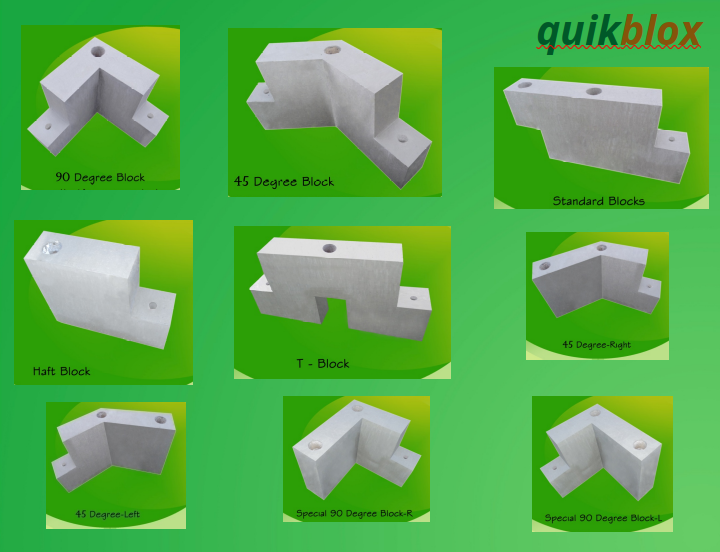
This scientific relationship forms the foundation of the Quik Blox design principles. Quik Blox Engineering Solutions applies these design principles through specifically and scientifically designed modular interlocking components and mathematically engineered configurations that address specific hazards.
Each configuration utilizes material science, structural mechanics, and geometric design principles to reduce the probability of structural failure and property loss, ultimately leading to a reduced loss of life in disaster prone and other vulnerable environments.
Compressive Strength
Compressive strength measures the capacity of a material to resist crushing forces. Concrete exhibits exceptionally high compressive strength and therefore performs well under loads that push material particles together. Most structural loads generated by gravity, earth pressure, and many impact events produce significant compressive forces. Engineers therefore utilize concrete mixtures as a primary structural material because it can withstand substantial compressive stresses without failure. The unique and proprietary aggregate mix of materials used in Quik Blox design principles increases the compressive strength and the ability of the Quik Blox design principles to mitigate damage and loss.
Tensile Strength
Tensile strength measures the capacity of a material to resist forces that pull material particles apart. Concrete possesses relatively low tensile strength when compared with its compressive capacity. Engineers address this limitation through geometry, reinforcement, confinement, and load path design. Structural performance therefore depends upon controlling how forces travel through a structure rather than relying solely upon material properties.
The Design Principles of Geometry and Math
Geometry serves as the mechanism that transforms material strength into structural performance. Structural forms determine the direction, concentration, and distribution of forces.
Arches can convert tensile stresses into compression. Buttresses can redirect lateral forces into foundations. Cellular structures distribute loads more evenly across multiple pathways. Interlocking systems create force transfer mechanisms that improve stability and resilience. The lack of mortar reduces the potential for stress points and other areas where failure first occurs.
Engineers utilize mathematical analyses to predict how structures respond to external loads. Force vectors, stress distributions, momentum transfer, fluid dynamics, and energy dissipation govern structural behavior during earthquakes, floods, hurricanes, landslides, impacts, and explosions. Effective disaster mitigation therefore requires designs that manage forces rather than merely resist them.
Quik Blox Engineering Solutions applies these principles through precision-engineered modular units. The system utilizes interlocking geometries that create continuous structural load paths. These load paths distribute forces throughout a structure rather than concentrating stresses within isolated locations. The resulting configurations increase stability while reducing the likelihood of localized failure.
The Science of Modern Design Principles in Construction
The scientific basis of the system extends beyond simple wall construction. Different configurations address different hazards through specific geometric arrangements.
Flood mitigation structures redirect water flow and reduce erosive forces.
Coastal protection systems attenuate wave energy through controlled turbulence and momentum reduction.
Retaining structures manage earth pressures through mass distribution and force redirection.
Impact-resistant configurations distribute concentrated loads across larger structural areas.
Seismic configurations promote controlled force transfer while limiting catastrophic collapse mechanisms.
Hydrodynamic and aerodynamic forces also illustrate the importance of geometry in disaster mitigation. Water and wind exert dynamic pressures that change according to velocity, direction, and surface interaction.
Strategic geometric configurations and design principles allow for the alteration of flow characteristics and reduce force concentrations. Structures can therefore decrease destructive loading through shape and arrangement rather than through increased material volume alone.
Redundant Design Principles
Redundancy represents another critical engineering design principle incorporated into the Quik Blox modular interlocking systems. Redundant load paths allow forces to bypass damaged areas and continue through alternate structural routes. This characteristic improves resilience during extreme events because localized damage does not necessarily trigger complete structural failure.
The mathematical foundation of these designs relies upon principles of equilibrium, stress analysis, fluid mechanics, energy transfer, and structural dynamics. Engineers evaluate anticipated hazards and develop configurations that optimize force management for specific environmental conditions. Each configuration therefore reflects a calculated response to identifiable risks rather than a generic construction solution.
The scientific principles of compressive strength, tensile strength, and structural geometry form the foundation of resilient infrastructure. Material properties provide the capacity to resist forces, while geometry determines how those forces move through a structure. Quik Blox Engineering Solutions integrates these principles into modular systems that utilize engineered configurations to address specific disaster scenarios.
The significance of this approach to design principles extends beyond construction efficiency because it focuses on the management of forces that cause structural damage. From an engineering perspective, the system demonstrates how mathematical design, material science, and structural mechanics can combine to create specialized configurations that reduce property loss and improve resilience against natural and man-made hazards